Back to portfolio
Case study

Codebase reporting system that turns complex repositories into readable technical briefs.

WanWiki turns a repository into a structured report and publishable wiki so engineering leads, reviewers, and new team members can understand a codebase faster without relying on loose Q&A.

Project context

This page is a product capability review based on the live WanWiki MVP, its generated output, and its test-backed pipeline. The story is intentionally grounded in what the product already proves well: readable repository briefs, traceable evidence, and publishable documentation.

Case file

Best fit

Engineering teams, technical reviewers, and onboarding workflows

What it produces

A structured markdown brief with an optional published wiki layer

Why it is credible

Every report stays tied to persisted artifacts, evidence, and validation

Delivery story

The project in sequence

01

The problem

Large repositories are hard to explain quickly. New team members need orientation, technical leads need a concise brief, and reviewers need a way to see the important modules, flows, and risks without reading everything from scratch.

A lot of codebase-understanding tools jump straight to interactive Q&A. That can feel impressive in a demo, but it makes trust fragile because the answer surface becomes easier to drift away from grounded evidence.

02

The product

WanWiki takes a report-first approach. Given a repository, it produces a structured markdown brief that covers repository structure, major modules, important flows, architectural boundaries, risks, and open questions in one readable package.

That same output can also be published as a navigable wiki surface, which makes the product useful both as an internal technical brief and as a knowledge layer people can return to later.

03

Why it feels trustworthy

The strongest product decision is restraint. WanWiki does not lead with open-ended repository chat. It leads with a compile-first report pipeline and uses bounded AI roles inside a workflow that keeps analysis, validation, and publication explicit.

That makes the final report easier to trust and easier to operationalize. The output stays tied to run artifacts, can be validated and resumed, and can be published without breaking the canonical report trail behind it.

Observed stack

TypeScriptNode.jsKnowledge GraphQuartzSchema validationBounded AI roles

Reader outcomes

Orientation speed

Faster codebase understanding

Output surface

Brief + wiki

Trust posture

Traceable and validated

Published output

The output is the product: a readable technical brief first, with a wiki surface when navigation matters.

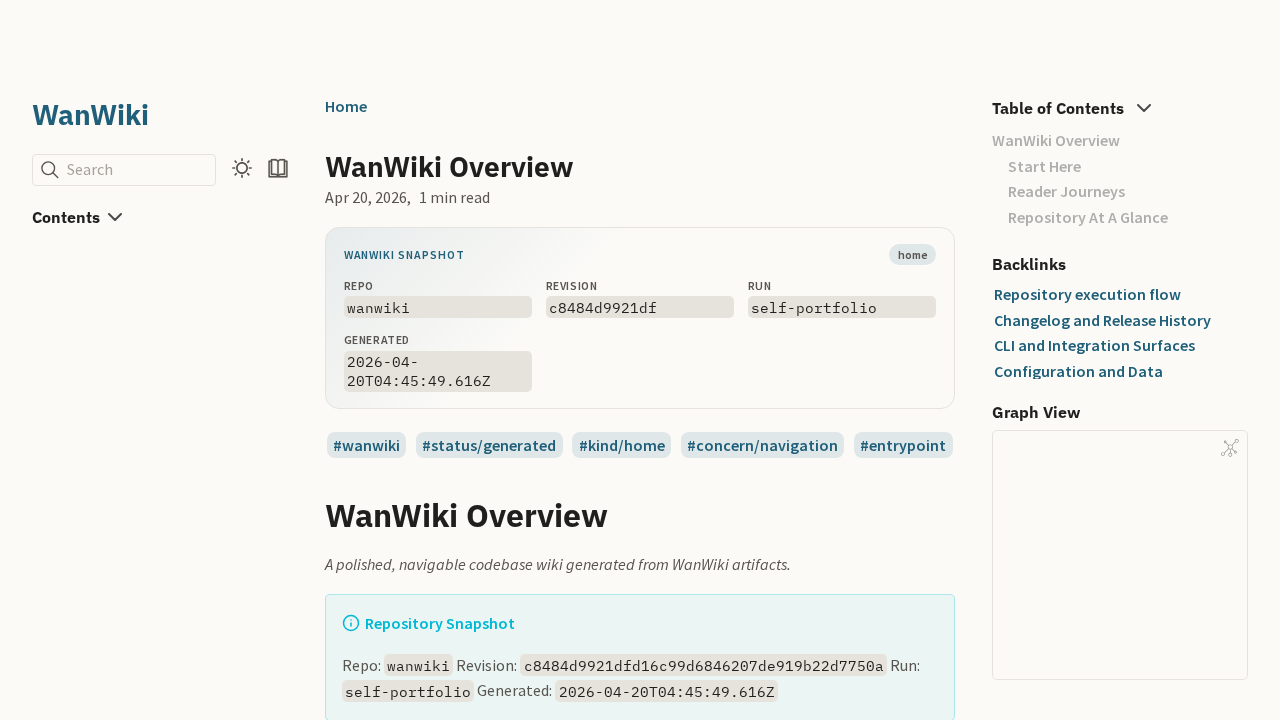
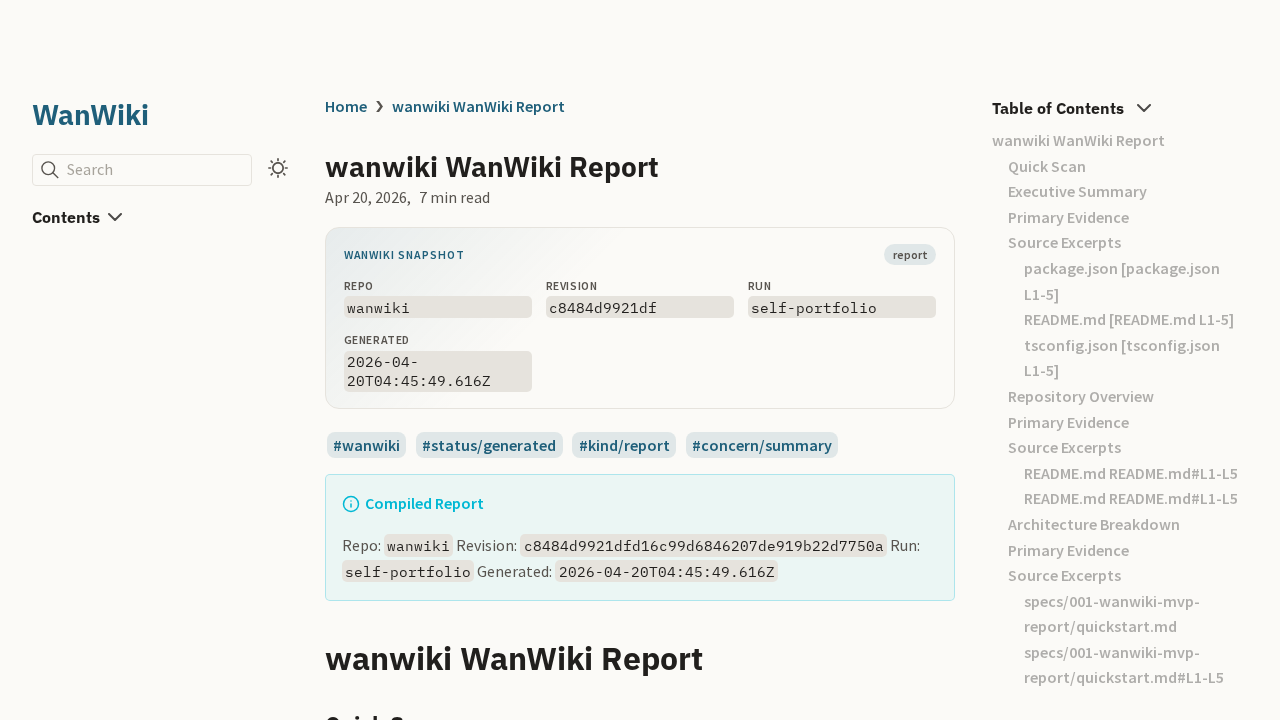
These screenshots come from a real WanWiki run on the WanWiki repository itself. They make the value easier to grasp than the implementation alone because you can immediately see the report shape, the navigation layer, and the run metadata that support trust.

WanWiki overview page generated from a real run on the WanWiki repository.
Overview surface: the generated wiki presents repository snapshot data, navigation, backlinks, and graph-driven structure as a technical brief people can actually browse.
WanWiki compiled report page generated from a real run on the WanWiki repository.
Compiled report view: the published report stays tied to run metadata, indexed sections, and concrete source evidence instead of floating as an ungrounded summary.

How it works

A private, searchable codebase reference for onboarding, review, and technical diligence.

WanWiki compiles the repository into a browsable technical wiki, then lets the team search and ask focused questions against that indexed knowledge. It is built for private engineering work where source grounding and local control matter.

01

Start with something readable

WanWiki first turns the repository into a browsable technical wiki, so the team gets pages, navigation, backlinks, and focused deep dives instead of a single wall of generated text.

02

Ask focused follow-up questions

Once the knowledge base is in place, the team can search it and ask targeted questions against the indexed repository material instead of rebuilding context from scratch each time.

03

Keep private code in a local-first workflow

WanWiki works especially well for private codebases because the generated wiki, search layer, and supporting artifacts can stay in a local-first environment rather than being pushed into a generic hosted chat flow.

04

Stay close to the real source material

The system uses repository structure, compiled artifacts, verification, and source-linked outputs to keep the result grounded. That gives teams something much easier to trust than a generic repo chatbot.

Why it is credible

The advantage is not prettier documentation. It is a codebase knowledge system teams can actually use.

01

One run creates more than a report

WanWiki is built so the generated wiki can become a working knowledge base. The repo includes search and query flows over generated pages, repository docs, source files, and configuration instead of treating the report as a dead-end export.

02

A better fit for private engineering environments

The active requirements and integration docs support local repository intake, local run workspaces, optional local retrieval, and local publishing. That makes WanWiki easier to use where teams care about control, privacy, and internal review.

03

More trustworthy than a generic repo chat tool

WanWiki combines structural analysis, compiled knowledge artifacts, verification, and targeted repair. The result is a technical reference built on organized evidence, not a chat-first tool that has to rediscover the codebase on every question.

04

Useful internally and publishable when needed

WanWiki already ships a markdown-first report bundle and an optional Quartz publication layer, so the same run can support onboarding, technical review, and a cleaner shared wiki without creating a second source of truth.
Related use cases

Problems this proof can support

This proof stays project-specific. Related use cases show the broader situations where similar system shapes can help.

Bespoke software use case

Building internal tools when generic software does not fit.

This situation is for teams whose work has outgrown spreadsheets, inboxes, and generic SaaS, but does not fit neatly into an off-the-shelf platform.

See the use case

Knowledge and decision systems use case

Connecting knowledge, data, and decisions in one usable system.

This situation is for companies where the information exists, but people cannot find it, trust it, connect it to the workflow, or use it to make decisions consistently.

See the use case

Next step

If your team is still re-explaining the same codebase, we can help turn that into something clearer.

WanWiki is a strong fit when onboarding, architecture review, or repository handoff still depends too much on scattered notes and repeated explanations. The goal is not more output. It is one clearer place to read, search, and reuse technical understanding.

Where onboarding or architecture review is slowing the team down

What a first useful knowledge surface should actually include

How privacy, local-first constraints, and publishing needs shape the build

A first conversation is usually enough to map the workflow, the constraints, and the right shape for a useful first version.